Showing posts with label Spain. Show all posts

Thursday, May 7, 2015

King Peter (Pedro) II Crusader and Defender of the Catholic Faith!


Pedro II (1178-1213), known as “The Catholic”, was imbued with a profound religious devotion by his mother and saw his role as a knight champion of Christianity very much in that context. His generosity to the chivalric orders was prodigious. The Templars of Montpellier arranged for the marriage of the heiress of that city to Pedro who despite a marked attraction to women took a total adversion to his legitimate spouse, to the extent of refusing to consummate the marriage, and eventually seeking to divorce her. The marriage was in fact consummated as a result of trickery by the queen in an episode regarded by their ensuing son as a miracle.

Pedro made his way to Rome in 1204 to be solemnly crowned there by Innocent III. Meanwhile in Languedoc the Albigenisan heresy sprang up with the active support and participation of certain of the local rulers among whom Pedro had solemn allies and vassals. In order to defend them and in spite of his own orthodox beliefs, Pedro met the Catholic armies from northern France under Simon de Montfort before the castle of Muret and despite his own numerical superiority he lost the battle and his own life in the course of it. The infant son from the miracle of Montpellier, the great-grandson of Raymond and Petronila, who succeeded to the throne in 1213, was James I (King also in due course of Majorca and Valencia, Count of Barcelona and Urgell, Lord of Montpellier) known to history as “the Conqueror”.


In 1212 Peter he helped Alfonso VIII of Castile to defeat the Moors at Las Navas de Tolosa.   This battle was the turning point in the history of Medieval Iberia. The forces of King Alfonso VIII of Castile were joined by the armies of his rivals, Peter II of Aragon and Alfonso II of Portugal to fight the Muslim Almohad rulers of the southern half of the Iberian Peninsula.   Caliph al-Nasir led the Almohad army. The defeat of the Almohads signaled the beginning of a long decline in the power of the Moors in the Peninsula.  

Following his performance against the Moors, Peter II was the most famous and respected crusader of the period.   He had driven the Moslems from much of Spain, and won plaudits from the Papacy for his leadership.   But Peter's problems had already started when the crusaders purported to replace Raymond-Roger Tranceval as Viscount of Carcassonne and Beziers in 1209.   How could they do this?  Feudal law was absolutely clear that it was for Peter as suzerain, to appoint, confirm and dispossess his own vassals - but now Innocent had a legal claim to be Peter's suzerain.   Even the Northern Lords were uneasy about this precedent.   As they clearly saw, if Innocent III got away with this then neither they nor any sovereign in Christendom would be safe.

Peter returned from Las Navas in the autumn of 1212 to find that in the course of the Cathar Crusade.  Simon de Montfort had conquered Toulouse, exiling Raymond VI Count of Toulouse, Peter's vassal and brother-in-law. Peter crossed the Pyrenees and arrived at Muret in September 1213 to confront de Montfort's army. He was accompanied by Raymond of Toulouse, who gave Peter excellent counsel, to avoid battle and instead to starve out Montfort's forces. This suggestion was rejected as unknightly. Peter fought at the subsequent battle of Muret in 1213, but was killed during a needless show of bravado.   (He was fighting in disguise - a common ploy for kings at the time and not apparently regarded as unknightly. A lowly vassal armed as the King of Aragon attracted the scorn of the Crusaders and Peter, unable to contain himself, shouted out something to effect of "here I am, come and get me".) He died, as brave as he was foolish at the hands of two French Crusader knights.

The death of the most famous Crusader in Europe, a King, surnamed the "Catholic", fighting against brother crusaders, shook both armies and indeed left the whole of Christendom horrified and bewildered.  

The Holy Lands on the Frontiers - Spain


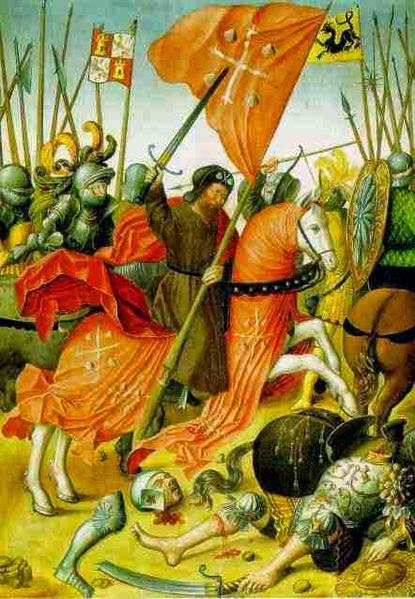
The Apostle of Christ and Holy War. A painting attributed to the Circle of Juan de Flandes (c.1510–20) of Saint James fighting the Moors. He is shown carrying the banner of the Spanish military order bearing his name, the Order of Santiago. The incongruity of this transformation of one of Jesus’s disciples into a warrior saint escaped most medieval observers.

In Spain, as in the Baltic, crusading was secondary or complementary to secular considerations and wider association of Christian conquest and holy war. A decade before the First Crusade, Alphonso VI of Castile had characterized his capture of Toledo from the Moors in 1085 ‘with Christ as my leader’ as a restoration of Christian territory and the recreation of ‘a holy place’. It is not entirely clear how far the explicit religiosity of twelfth-century accounts of earlier campaigns against the Moors in Spain reflected the assimilation of crusading formulae, an older tradition of holy war or a separate local development. While defence and restoration of Christian lands matched the new rhetoric of the Jerusalem war, indigenous writers and religious leaders transformed the Iberian patronal saint, the Apostle James the Great, Santiago, into a ‘knight of Christ’ and heavenly intercessor for the success of Christian warfare. Such promotion of a distinctive pan-Iberian war cult helped local rulers retain ownership of their campaigns even when enjoying papal crusade privileges while at the same time reinforcing Christian solidarity. St James, an international saint through his shrine at Compostella, did not become the exclusive preserve of any one Iberian kingdom, his cult sustaining the political ideologies of all of them. The same was generally true of the half dozen Iberian Military Orders founded in the second half of the twelfth century, including one dedicated to St James.

Crusading in Spain adopted a local flavour. The great warrior kings of the thirteenth century, Ferdinand III of Castile (1217–52) and James I of Aragon (1213–76), rolled back the Muslim frontier self-consciously in the name of God and each flirted with carrying the fight beyond Iberia, to Africa or Palestine. Yet neither found the commitment that led their contemporary Louis IX of France to the Nile. Although some conquests, such as the capture of Cordoba by Ferdinand III in 1236, were accompanied by religious gestures of restoration and purification familiar from the eastern crusades, and in places, as at Seville (captured 1247), foreign Christian settlers were recruited, much of the Reconquista involved negotiation and accommodation of the religious and civil liberties of the conquered: James I ‘the Conqueror’ of Aragon’s annexation of Mallorca (1229) and Valencia (1238), and Ferdinand III’s conquest of Murcia (1243). Christian complaints about the calls of the muezzin persisted in some areas for centuries. Although suffering from the problems of being ruled by an elite with separate laws and religion, Muslims under Christian rule, the mudejars, and Jews and converts – conversos (Jewish converts to Christianity) and Moriscos (Muslim converts) – were a feature of Spanish life until the late fifteenth and sixteenth centuries, when a recrudescence of a manufactured neo-crusading religious militancy led to the imposition of intolerant Christian uniformity under the Catholic monarchs Ferdinand II of Aragon (1479–1516) and Isabella of Castile (1474–1504), coinciding with the final expulsion of the Moorish rulers from Granada (1492). This new identification of a crusading mission, which persisted under Charles V and Philip II, depended as heavily on recasting Castile, in particular, as itself a new Holy Land with a providential world mission as it did on genuine Aragonese crusading traditions. In turn, this spawned a myth of the crusading reconquista and the providential identity and destiny of Catholic Spain later insidiously expropriated by General Franco and his fascist apologists, academic as well as political.

The fate of Peter II of Aragon (1196–1213), father of James the Conqueror, reveals the nuances and contradictions in the Iberian experience. The twelfth-century invasion of Spain by the Almohads, Muslim puritans from North Africa, had placed the Christian advances of the previous century in jeopardy. In 1212, a large international crusader host combined with Iberian kings to resist. Before confronting the Almohad forces at Las Navas de Tolosa, most of the French contingents abandoned Peter and the kings of Castile and Navarre, partly over disagreements over the local rulers’ leniency towards defeated Muslim garrisons, a frontier pragmatism that, as in Palestine, struck the French as scandalous. They also did not care for the heat. The subsequent Christian victory became, as a result, almost wholly a Spanish triumph, a useful detail in the later projection of Spanish destiny. Fourteenth months later Peter was defeated and killed at the battle of Muret in Languedoc by an army of French crusaders led by the church’s champion, Simon de Montfort, testimony to the political cross-currents upon the surface of which crusading bobbed, and the impossibility of divorcing ‘crusade’ history from its secular context.

After the conquests, new (or in propaganda terms restored) sacred and secular landscapes were created, from converting mosques to churches to changing Arabic place names. In some areas, notably in Castile, immigrant settlement from further north was encouraged. Elsewhere, the pre-conquest social and religious structures felt only modest immediate impact. It may be significant of a decline in frontier militarism that after 1300, the cult of Santiago faded before that of the Virgin Mary. Nonetheless, the holy war tradition, in its crusading wrapping, persisted amongst the knightly and noble classes, available to those engaged in wars against infidels, Muslim or heathen, a living cultural force as well as a stereotype. While his captains were observing West Africans outside the straitjacket of crusading aesthetics, the Portuguese prince Henry the Navigator (1394–1460) fervently embraced crusading aspirations and campaigned in North Africa. As late as 1578, a Portuguese king, Sebastian, at the head of an international force armed with indulgences and papal legates, fought and died in battle against the Muslims of Morocco. The penetration of Latin Christendom into the islands of the eastern Atlantic in the fourteenth and fifteenth centuries attracted crusading grants for the dilatio, or extension, of Christendom. The Iberian tradition ensured a sympathetic hearing for the Genoese crusade enthusiast Christopher Columbus. It formed one strand in the conceptual justification for the conquest of the Americas and, more tenuously, in the mentality of the slave trade which some saw as a vehicle for expanding Christianity. This was made possible by the idea, popular by c.1500, that Spain itself (however imagined) was a holy land, its Christian inhabitants new Israelites, tempered and proved in the fire of the Reconquista, championing God’s cause whether against infidels outside Christendom or heretics within.

Battle of Las Navas de Tolosa


Date
July 16, 1212
Location
Near Las Navas de Tolosa, JaƩn, Andalusia,
Result
Decisive Christian victory
Belligerents
(1)Castile
Aragon
Portugal
Navarre
(2)Almohads
Commanders
(1)Alfonso VIII of Castile
Sancho VII of Navarre
Peter II of Aragon
(2)Muhammad al-Nasir
Strength
(1)~50,000 some sources suggest it was between 50,000 - 80,000
(2)~125,000 - 150,000
Casualties and losses
(1)~2,000 dead or wounded
(2)~100,000 dead, wounded, or captured

In 1195 the Castilians, under Alfonso VIII, met the combined armies of the Muslims at Alarcos, south of the city of Toledo. Details of the battle indicate just how hard it was fought. The initial Castilian charge was successful and drove back the Muslims, breaking their line, and killing the general, Abu Hafas, who died trying to rally the broken Muslim infantry. The tribe of Henteta, Muslims from North Africa, was surrounded and cut to pieces. However, the battle suddenly turned when the Muslims of al-Andalus charged striking where Alfonso VIII stood with his bodyguard. The Spaniards broke and fled, losing thousands. The battle of Alarcos, near Ciudad Real, was thus an overwhelming Muslim victory. It was also the beginning of the end for Muslim Spain. Castile's defeat at Alarcos made the various Christian states understand that only cooperative action would defeat the newly unified Muslim power. They began to forget their jealousies and concentrate on the reconquest. Following up on their victory, the Moors invaded Castile, but Alfonso VIII repulsed them. 

By 1212, the Christians were ready to strike in force. Under Alfonso VIII they marched into the heart of Moorish Spain and offered battle at Las Navas de Tolosa. Alfonso's army of 2,000 French knights, 10,000 Spanish horse, and 50,000 infantry advanced south and was confronted by the Almohad Muhammad I, with perhaps 200,000 men. Shortly before the battle, however, the French abandoned Alfonso VIII, complaining of the effect of the heat and their armor. When Muhammad I learned of the French departure, he moved briskly north to intercept the now weakened Christian army. The two armies met with the Moors massed in the narrow entrance of the Losa canyon. In a repetition of the events at Thermopylae, where the Spartans faced the Persians, a Spanish shepherd led the Christian army through an otherwise unknown mountain path that brought them into the Moorish rear. The stunned Moors found Alfonso VIII's army deployed behind them on the plain of Mesa Del Rey, and blocking their front at the narrows of the pass. Both sides rested their armies until July 16, when the battle was joined. The Spaniards attacked and overwhelmed the Muslim light infantry forming the first line. The heavily armored Christian knights pushed back the two wings of the Almohad Moorish army, but the Moorish center, mostly cavalry, held fast and launched repeated counterattacks. The end came when these failed and the whole army suddenly broke and fled the field. Muhammad I fled all the way to Jaen as the Moorish cavalry and infantry became thoroughly mixed and confused. A massacre followed, and 150,000 Muslim warriors are reputed to have died that day. The Moorish defeat gave Alfonso VIII control of central Spain. 

The Battle of Las Navas de Tolosa can fairly be considered among the most important in history. It was not the end of Moorish Spain, but it marked the defeat of the last great Muslim army, and the occupation of the heart of the Peninsula by the Christians. If it was not the end, it was certainly the beginning of the end. 

The war continued until 1235, when Ferdinand III of Castile recaptured Cordoba. Seville was taken in 1248 and Jaen in 1246. Valencia fell to King Jaime I of Aragon. Though infighting troubled both sides, it was far worse among the Moors. Fractured by internal dissent, they were steadily driven back by the Spanish. 

In 1340 Alfonso XI of Castile, supported by Alfonso IV of Portugal, routed a considerably larger Moorish force at Rio Salado, near Tarika. The Moorish army was formed of warriors who had recently arrived from Morocco where the general idea of a holy war against the Christians provided the Marinid Moorish armies of Spain with a constant supply of Berber and Arab recruits. Despite this, all that remained of Muslim Spain was a region along the Mediterranean coast extending from near Gibraltar to the northeast near, but not including, Cartagena. This last Granadan stronghold would not last long. 

In 1487 the Christians captured the city of Malaga, in the province of Granada. They then pushed against and laid siege to the capital, Granada itself. No major assaults were made, as both sides knew that a Muslim surrender was inevitable. No relief could be hoped for from North Africa. A capitulation signed in November 1491 set the date of surrender at January 2, 1492. When January 2 arrived, the gates were opened and the Muslim occupation of Spain ended.